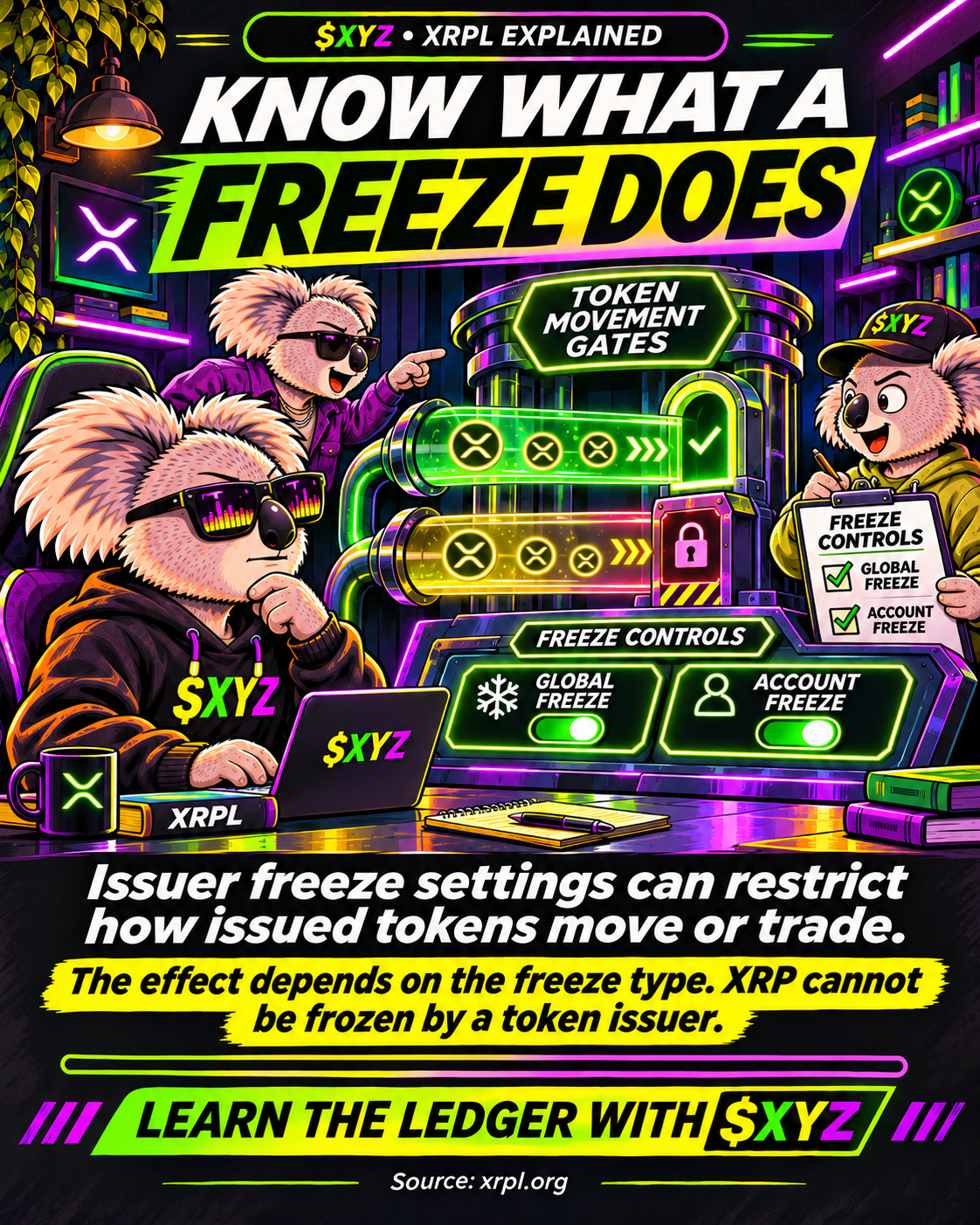
Know what a freeze does
Issuer freeze settings can restrict how issued tokens move or trade. The effect depends on the freeze type. XRP cannot be frozen by a token issuer.
Kev holds XRP and a token issued by another project. One day, he can still see the token balance in his wallet, but cannot send it to a mate or sell it.
One possible explanation is an issuer freeze. For tokens that use trust lines, the issuer’s freeze settings can restrict movement and trading without removing the displayed balance.
What does a freeze affect?
An issuer can apply freeze controls to its own issued tokens. It cannot use those controls to freeze Kev’s entire account, his XRP or tokens from unrelated issuers.
That distinction matters: a restriction on one token does not mean his whole wallet has stopped working.
XRP has no token issuer and cannot be frozen through these controls. A custodial exchange can still restrict withdrawals from its own platform, which is a separate issue from freezing XRP on the ledger.
How do the freeze types differ?
For trust-line tokens, the main types are:
- Individual freeze: Restricts a particular trust line. Kev cannot send the affected tokens to other holders, and his offers to sell them are treated as unfunded. He can still receive those tokens and send them directly to the issuer.
- Deep freeze: Adds restrictions on receiving from other holders and on buying the affected tokens. Direct payments between holder and issuer remain possible.
- Global freeze: Applies across the issuing account’s trust-line tokens. Transfers between holders and selling those tokens are restricted, while direct payments to and from the issuer remain possible.
The poster’s “account freeze” is best understood here as an individual trust-line freeze, rather than a freeze of everything Kev owns.
What should Kev check before holding a token?
Kev checks the issuer address, the issuer’s account settings and any freeze affecting his trust line. A familiar ticker alone does not establish which asset he holds.
An issuer can enable No Freeze to permanently give up individual and deep freezing. There is an important exception: it can still enable a global freeze, but then cannot turn that global freeze off.
A freeze also does not itself remove tokens from Kev’s balance. Clawback is a separate capability with separate requirements.
Kev’s tip: Check what an issuer can control before buying its token. A visible balance does not always mean those tokens are transferable or tradeable.
Sources
#XRPLEducationMonth