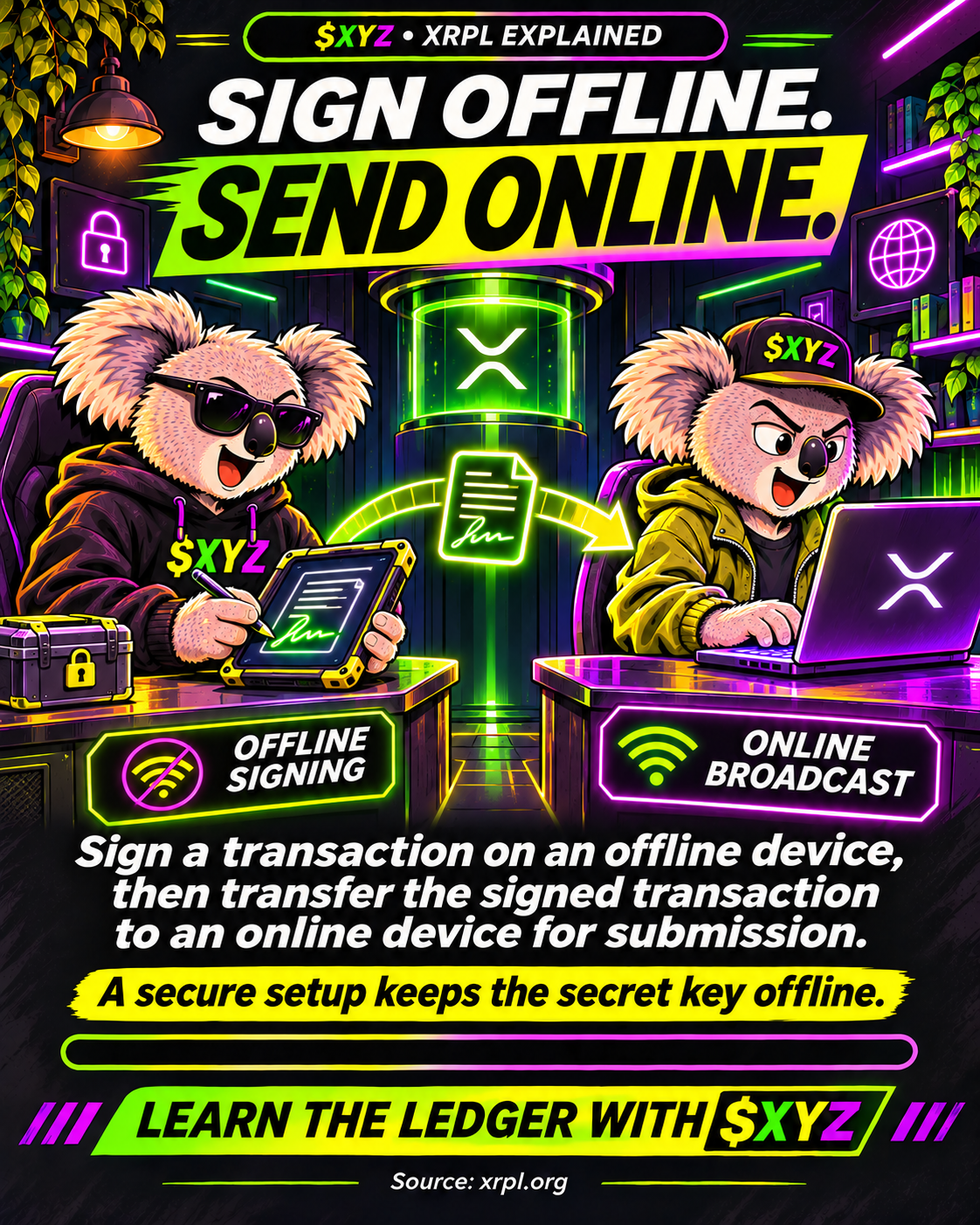
Sign offline. Send online.
Sign a transaction on an offline device, then transfer the signed transaction to an online device for submission. A secure setup keeps the secret key offline.
Kev wants to send 25 XRP from the community treasury to a designer. He prepares the payment on an internet-connected computer, but keeps the treasury’s secret key on a separate offline device.
With offline signing, he can authorise the transaction without putting that secret key on the online computer. The signed transaction then goes online for submission to the XRP Ledger.
What happens when Kev signs offline?
Signing creates a digital signature that authorises the transaction’s specific instructions. It does not move the funds by itself.
Before signing, Kev checks the destination address, amount, any required destination tag and the transaction fee on his trusted signing device.
The transaction also needs the correct account sequence number, or a valid Ticket. An offline device cannot fetch current ledger information itself, so those details must be supplied beforehand.
Keeping the key offline reduces its exposure to online attacks. The signing device and its software still need to be trustworthy.
What gets transferred to the online device?
Kev transfers the signed transaction, commonly represented as a transaction blob. His secret key and recovery phrase stay offline.
The online device submits that signed data to an XRPL server. It does not need Kev’s secret key to do this.
The signature protects the signed instructions: changing the destination or amount would invalidate it. However, anyone holding a valid signed transaction can submit it, so Kev should only release it when he is ready for it to execute.
Signing offline and broadcasting online are separate steps. Neither step alone proves that the payment succeeded.
How does Kev know the payment is complete?
Kev checks the transaction’s hash and confirms that it appears in a validated ledger with a successful result. An initial submission response can be provisional.
He can also include LastLedgerSequence, which sets the latest ledger in which the transaction may be included. This prevents an unconfirmed payment from remaining eligible indefinitely.
That deadline must allow enough time for the offline signing and transfer process. If it passes, Kev checks the original transaction’s final status before preparing another payment.
Kev’s tip: Move the signed transaction between devices, never the secret key. Check the details before signing and the validated result after submitting.
Sources
#XRPLEducationMonth