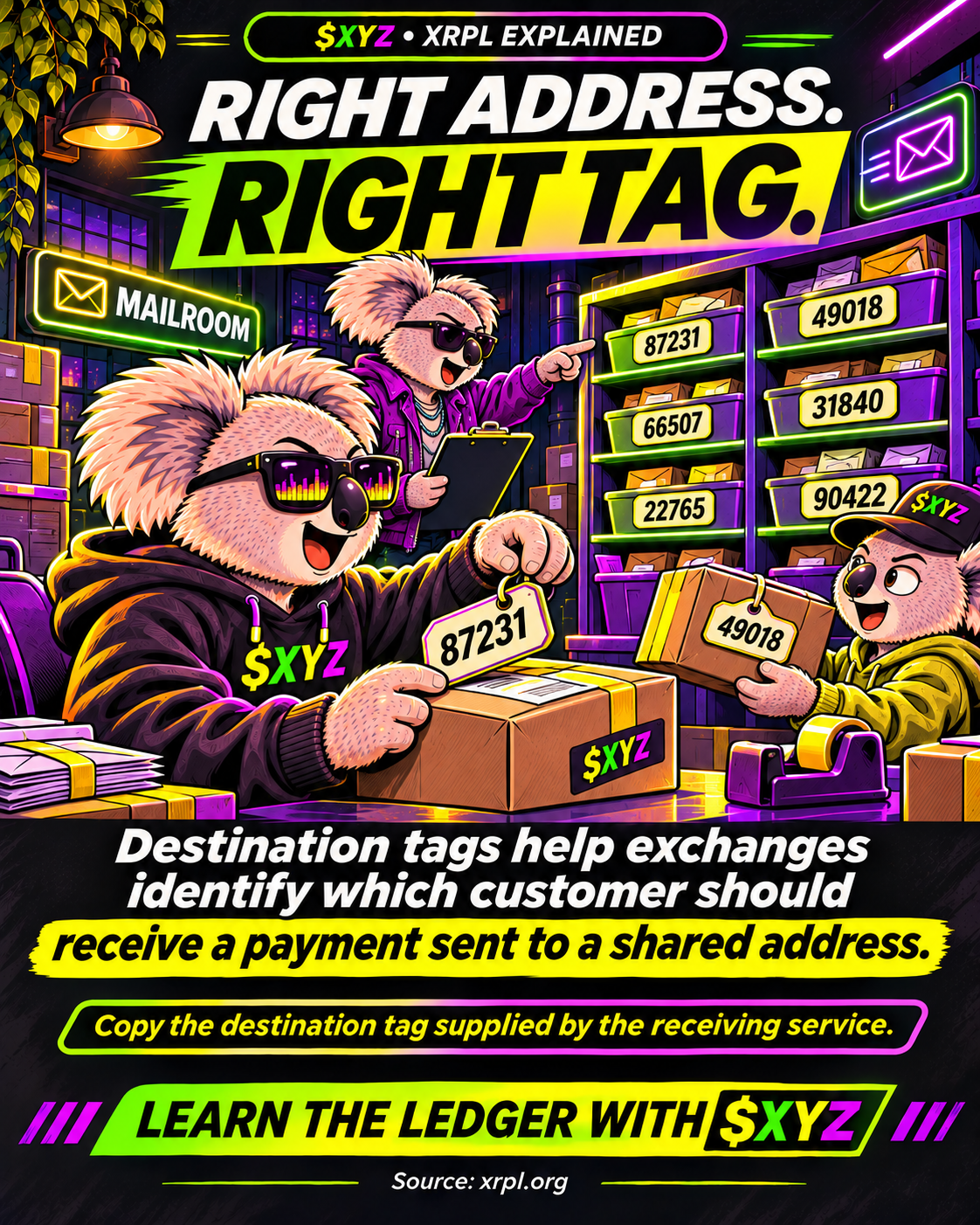
Right Address. Right Tag.
Destination tags help exchanges identify which customer should receive a payment sent to a shared address. Copy the destination tag supplied by the receiving service.
Kev wants to deposit 50 XRP into his exchange account. The exchange gives him a deposit address and a destination tag: 87231. His mate uses the same exchange address but has a different tag. Both payments reach the exchange’s wallet; the tags help its system work out whose balance to credit.
What does a destination tag do?
A destination tag is a number included with a payment. Exchanges and other services can use it to identify the customer or purpose behind a transfer to a shared address.
Think of the address as the mailroom and the tag as the numbered pigeonhole. The address gets Kev’s payment to the exchange. The tag tells the exchange where to allocate it in its own records. It does not create a separate wallet on the ledger.
What happens if Kev forgets the tag?
An account can enable Require Destination Tag, which makes the ledger reject payments that omit one. If that setting is not enabled, a payment without a tag can reach the exchange without being automatically credited to Kev.
Entering the wrong tag can also cause trouble. The ledger cannot check whether a tag belongs to Kev in the exchange’s customer database. A payment can succeed on-ledger while the exchange credits it incorrectly or needs to investigate.
If this happens, Kev should contact the receiving service’s official support with the transaction hash and deposit details. Any recovery depends on that service’s procedures.
Does every payment need a tag?
No. A payment to someone’s own wallet generally does not need one unless the recipient requires it. Kev should follow the receiving service’s current deposit instructions and copy the tag it supplies, rather than inventing a number or reusing one from another service.
Some services support an X-address, which combines the account address and tag in one encoded address. When using a classic address with a separate tag field, Kev needs to check both before sending.
Kev’s tip: Treat the deposit address and destination tag as a pair. The right address gets funds to the service; the right tag helps it credit you.
Sources
#XRPLEducationMonth