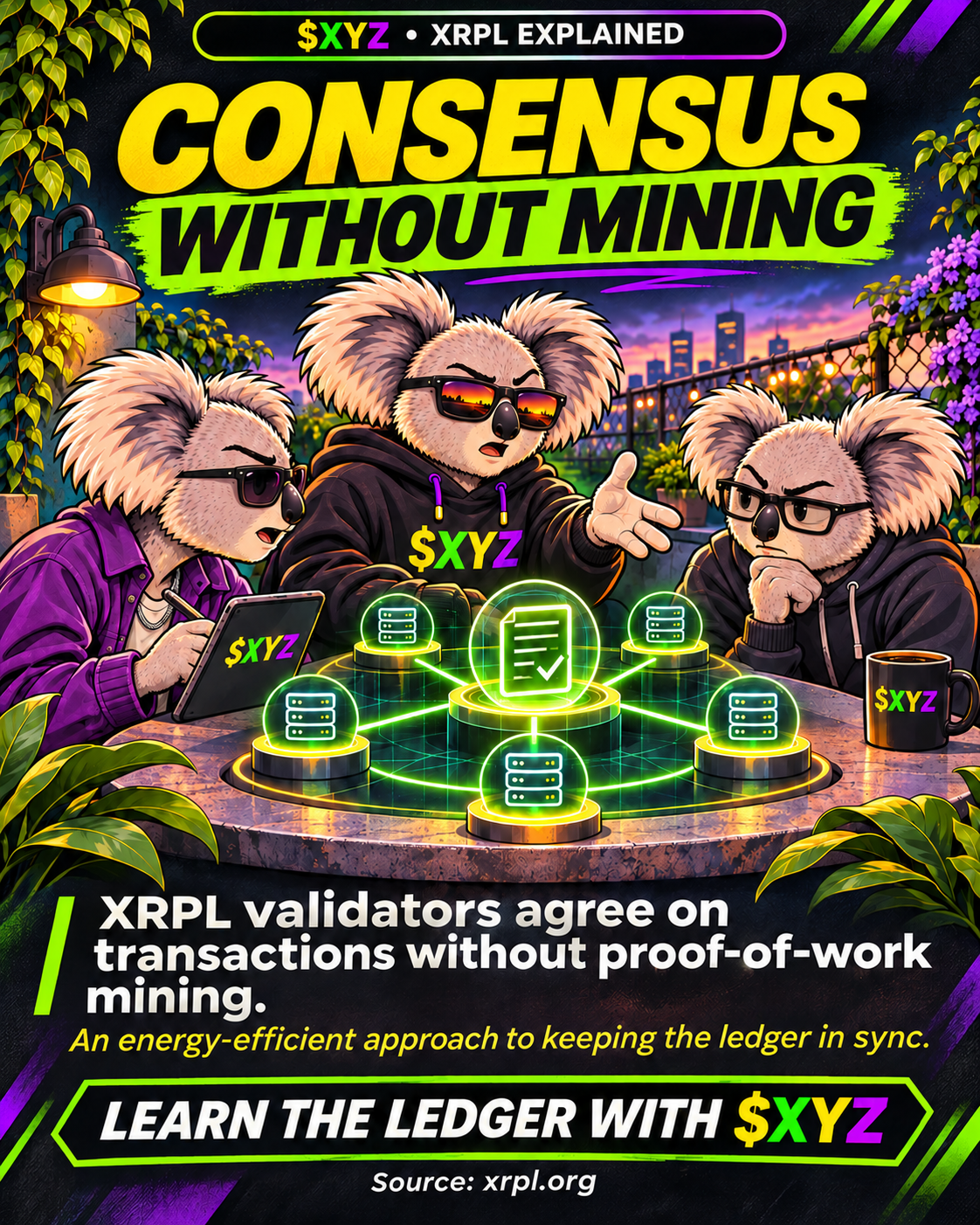
Consensus without Mining
XRPL validators agree on transactions without proof-of-work mining. An energy-efficient approach to keeping the ledger in sync.
Kev’s payment settled in seconds in Lesson 1. Now picture his wallet sending two payments at almost the same time, each trying to spend the same XRP. Different servers might see different payments first. How do they all end up with the same balances? That’s the job of consensus.
How do validators reach an agreement?
When you submit a transaction, servers relay it across the network. Messages can arrive in a different order at each server, so validators exchange proposals for which transactions to include in the next ledger version. They compare and revise those proposals until they reach agreement on a set. A transaction that arrives late can be picked up in a later round.
Servers then apply the agreed transactions in a consistent order, using the same rules. In Kev’s example, once one payment uses the available XRP, the other can’t spend those same funds. Validators publish signed messages identifying the ledger they calculated so servers can check that they arrived at the same result.
Whose agreement counts?
Each server uses a list of validators whose messages it counts, called a Unique Node List, or UNL. A server considers a ledger version validated when at least 80% of the validators on its list confirm the same result. The lists used by different servers need to overlap substantially so those servers can stay in sync. If a server sees too few matching validations, it waits for agreement before treating a result as final.
Where does the energy saving come from?
Proof-of-work mining relies on computers repeatedly trying calculations to win the right to propose a block. On the XRP Ledger, validators spend their computing power checking transactions, exchanging messages and signing the results. The servers still use electricity, and the protocol avoids the ongoing competition for computing power that mining requires.
Kev’s tip: Consensus gets the servers to agree on what to process. Validation confirms they got the same result.
Sources
- XRPL.org — Consensus Protocol
- XRPL.org — Consensus Structure
- XRPL.org — Consensus Principles and Rules
- XRPL.org — XRP Ledger Overview
#XRPLEducationMonth