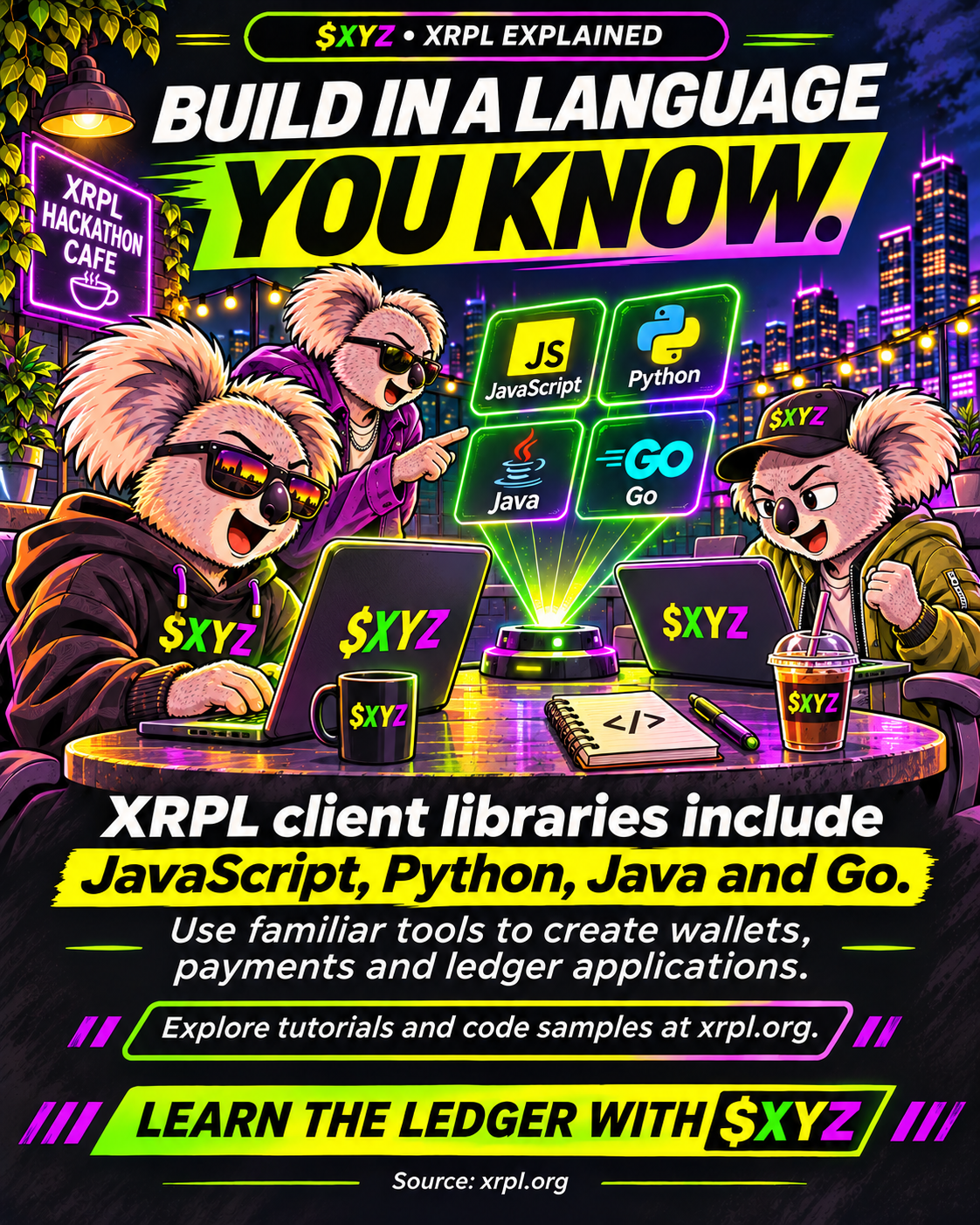
Build in a language you know.
XRPL client libraries include JavaScript, Python, Java and Go. Use familiar tools to create wallets, payments and ledger applications.
Kev and his mates want to build a website that shows their community treasury’s XRP balance. One knows JavaScript, another uses Python, and a third works with Java. XRPL client libraries help them connect their applications to the ledger using languages they already know.
What is a client library?
A client library is a collection of reusable code that helps an application communicate with the XRP Ledger. It simplifies common tasks, such as requesting account information, so developers can spend more time building the features people will use.
XRPL’s documentation lists xrpl.js for JavaScript and TypeScript, xrpl-py for Python, xrpl4j for Java and xrpl-go for Go. Each provides tools suited to its programming language.
How does Kev’s website get the balance?
Kev’s application connects to an XRP Ledger server and requests information about the treasury’s public address. The server returns account data, including its XRP balance, which the website can display. The library helps the application send that request and work with the response.
Reading a public balance does not require the treasury’s secret key. Kev can build this first feature without giving the website permission to spend the treasury’s funds.
Where should the team start?
The team can follow an XRPL.org getting-started tutorial for its chosen language. For example, the JavaScript tutorial walks through connecting to a server, creating a Testnet account and requesting account information. This gives them a small working application they can understand and build on.
They can practise on Testnet before connecting a finished application to Mainnet. A useful first goal is simply to fetch an account’s balance and display it correctly.
Kev’s tip: Start with one small feature in a language you know. Getting a balance onto a page is a practical first step towards building your own ledger application.
Sources
#XRPLEducationMonth